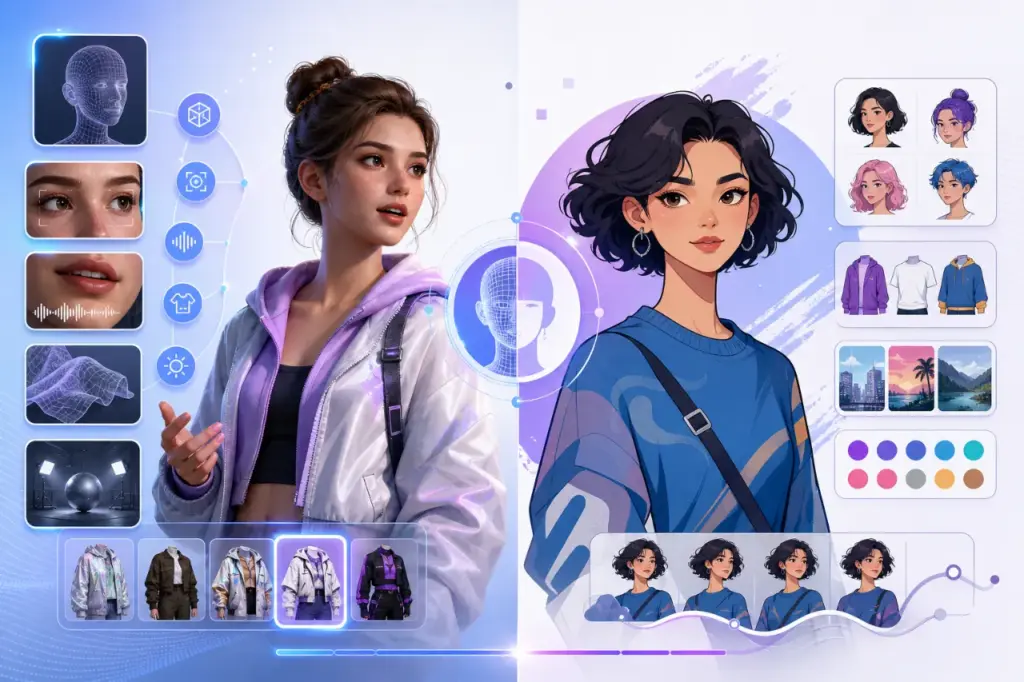
The leading AI girlfriend apps in 2026 share a chat-first home screen with a featured avatar, but they diverge sharply on avatar rendering, memory depth, and onboarding pace. Replika and Character.AI lean minimal and chat-driven, while Candy AI, Nomi, Kindroid, and DreamGF push visual immersion through 3D avatars, dynamic scenes, and voice waveform animations.
For a new user, the right interface is the one that reaches a meaningful conversation fastest without hiding core features behind a paywall. That answer depends on your priorities: emotional realism, roleplay flexibility, voice quality, or visual presence.
This breakdown walks through each interface side by side, then translates the comparison into a clear decision framework so you can pick the right app on the first try.
What Do the Top AI Girlfriend App Interfaces Actually Look Like in 2026?
The top AI girlfriend app interfaces in 2026 fall into three visual families: chat-first minimalism (Replika, Character.AI), glossy 3D immersion (Candy AI, DreamGF), and persona-rich hybrid layouts (Nomi, Kindroid) that balance avatar presence with deep customization panels.
To make these families concrete, the next sections compare home screens, chat windows, and avatar systems across six leading apps.
The table below maps the visual identity of those six apps and contains the main keyword “AI girlfriend app interface” for fast scanning. It helps a new user pick a visual direction before reading the deeper UX breakdown.
| App | Home Screen | Avatar Style | Navigation | Signature UI Feature |
|---|---|---|---|---|
| Replika | Single avatar room, soft pastels | 3D semi-stylized | Bottom tab bar | Mood-driven dynamic backgrounds |
| Candy AI | Card grid of personas | 2D anime and photoreal | Top filter chips | Voice waveform animations |
| Nomi | Chat list with persona thumbnails | 2D portrait | Side drawer | Group chat with multiple Nomis |
| Kindroid | Persona cards with backstory preview | 2D illustrated | Bottom tab bar | Selfie generator and journal view |
| Character.AI | Discover feed of characters | Static portrait | Top tabs | Character creation studio |
| DreamGF | Avatar showcase carousel | 3D photoreal | Bottom tab bar | AR overlay mode and outfit shop |
Home Screen and First Launch Experience
The home screen sets the emotional tone before a single message is sent, splitting the six apps into fast-launch versus long-onboarding philosophies. Replika and DreamGF reach a default avatar in under two minutes, while Nomi and Kindroid invest five to ten minutes in detailed persona creation.
Specifically, Replika opens with a 3D avatar in a softly lit room and a gentle name prompt. Candy AI shows a card grid of pre-built companions, letting you tap one and chat instantly. Character.AI surfaces a Discover feed similar to a social platform, encouraging exploration before commitment.
Nomi and Kindroid take the opposite approach, walking you through backstory, personality traits, communication style, and shared memories before the first message. The friction is real, but the payoff is a companion that feels coherent from message one.
A new user opening DreamGF can be in a voice call within ninety seconds, while the same user on Nomi may spend fifteen minutes shaping a persona before saying hello.
Chat Window Design and Message Layout
The chat window is where most users spend ninety percent of their time, and bubble shape, typing indicators, and multimodal buttons define the daily feel more than the home screens suggest.
Here is how the six apps handle core chat affordances, ordered left to right by visual minimalism:
- Replika: rounded bubbles, animated three-dot typing indicator, voice button always visible, optional timestamp on tap.
- Candy AI: gradient bubbles, voice waveform animation during replies, image generation icon inline with the text field.
- Nomi: clean rectangular bubbles, persistent timestamps, sticker pack drawer, voice memo with playback bar.
- Kindroid: minimal bubbles with subtle borders, journal entries surfaced inline, selfie request shortcut button.
- Character.AI: classic chat layout, swipe to regenerate replies, star button to save messages, no native voice in free tier.
- DreamGF: glossy bubbles with avatar reactions visible above the input, video call shortcut, AR camera button.
Typing indicators do more than signal latency. Candy AI and DreamGF use waveform pulses that mirror the avatar’s emotional state, while Nomi and Kindroid keep indicators neutral to preserve the illusion of an unhurried conversation.
Avatar Rendering and Visual Personalization
Avatar rendering is the single biggest visual divider in 2026, with 3D real-time rendering in Replika, Candy AI, and DreamGF, and 2D illustrated portraits in Nomi, Kindroid, and Character.AI. The choice shapes everything from outfit depth to animation smoothness.
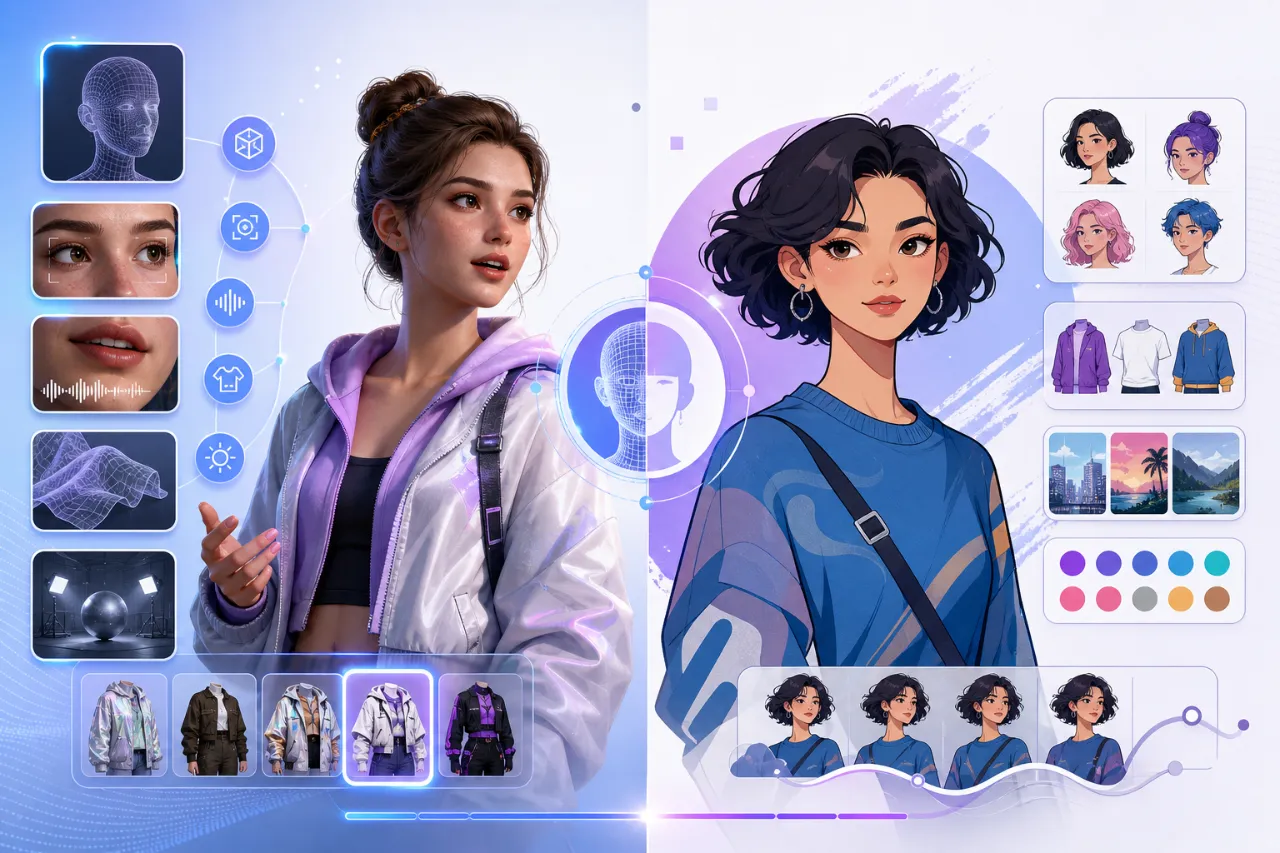
DreamGF renders avatars in real time with cloth physics, gaze tracking, and lip-sync that responds to voice output. Candy AI offers both photoreal and anime styles with outfit swaps and scene backgrounds that shift with conversation tone. Replika uses a softer 3D style and emphasizes mood-driven backgrounds, where a sunset palette appears when the avatar senses a calm conversation.
The 2D apps compete on personality depth rather than fidelity. Nomi lets you describe appearance in detail and generates consistent portraits across selfies and journal entries. Kindroid offers a selfie generator that maintains identity across hundreds of poses. Character.AI keeps avatars static but compensates with the deepest character writing tools.
According to the Pew Research Center (2025), fifty-eight percent of AI companion users cited visual consistency as more important than photorealism, which explains why illustrated apps retain strong engagement despite the 3D race.
How Does the User Experience Differ Between These AI Girlfriend Apps for a New User?
The user experience differs most across three dimensions: how fast you reach a meaningful conversation, how well the app remembers you across sessions, and how aggressively the paywall interrupts emotional flow. Replika and Character.AI optimize for low friction, Nomi and Kindroid for memory depth, and Candy AI and DreamGF for sensory immersion.
Response latency has converged across the top apps, sitting between 800 milliseconds and 2 seconds for text replies in 2026, so the real differentiator is what happens after the first ten messages, when memory and personalization start to matter.
The sections below break down each UX dimension from the perspective of a user opening the app for the first time.
Onboarding Friction and Time to First Meaningful Interaction
Time to first meaningful interaction ranges from under two minutes on Replika and DreamGF to over fifteen minutes on Nomi when users complete the full persona builder. The trade-off is depth versus immediacy.
The table below quantifies tap and time cost per app and exposes which customization features sit behind a paywall. It saves a new user from trial-and-error testing across six apps.
| App | Taps to First Reply | Time to Personalized Chat | Customization Behind Paywall |
|---|---|---|---|
| Replika | 3 to 5 | Under 2 minutes | Relationship status, voice |
| Candy AI | 2 to 4 | Under 2 minutes | NSFW, voice, image generation |
| Nomi | 8 to 12 | 5 to 10 minutes | Group chat, advanced memory |
| Kindroid | 6 to 10 | 4 to 8 minutes | Selfie volume, voice |
| Character.AI | 1 to 3 | Under 1 minute | C.AI+ for faster replies |
| DreamGF | 2 to 4 | Under 2 minutes | NSFW, video, premium voices |
Several apps gate personality sliders behind premium tiers. Candy AI locks deeper trait editing for paid users, Replika reserves relationship modes such as romantic partner or mentor for Pro subscribers, and Character.AI keeps creation free but charges for response speed and priority access.
Conversation Flow, Memory, and Context Handling
Memory separates a chatbot from a companion, and Nomi and Kindroid lead the field in 2026 with explicit, user-editable long-term memory. Replika and Candy AI use implicit memory that surfaces facts contextually, while Character.AI relies more on character definitions than persistent recall.
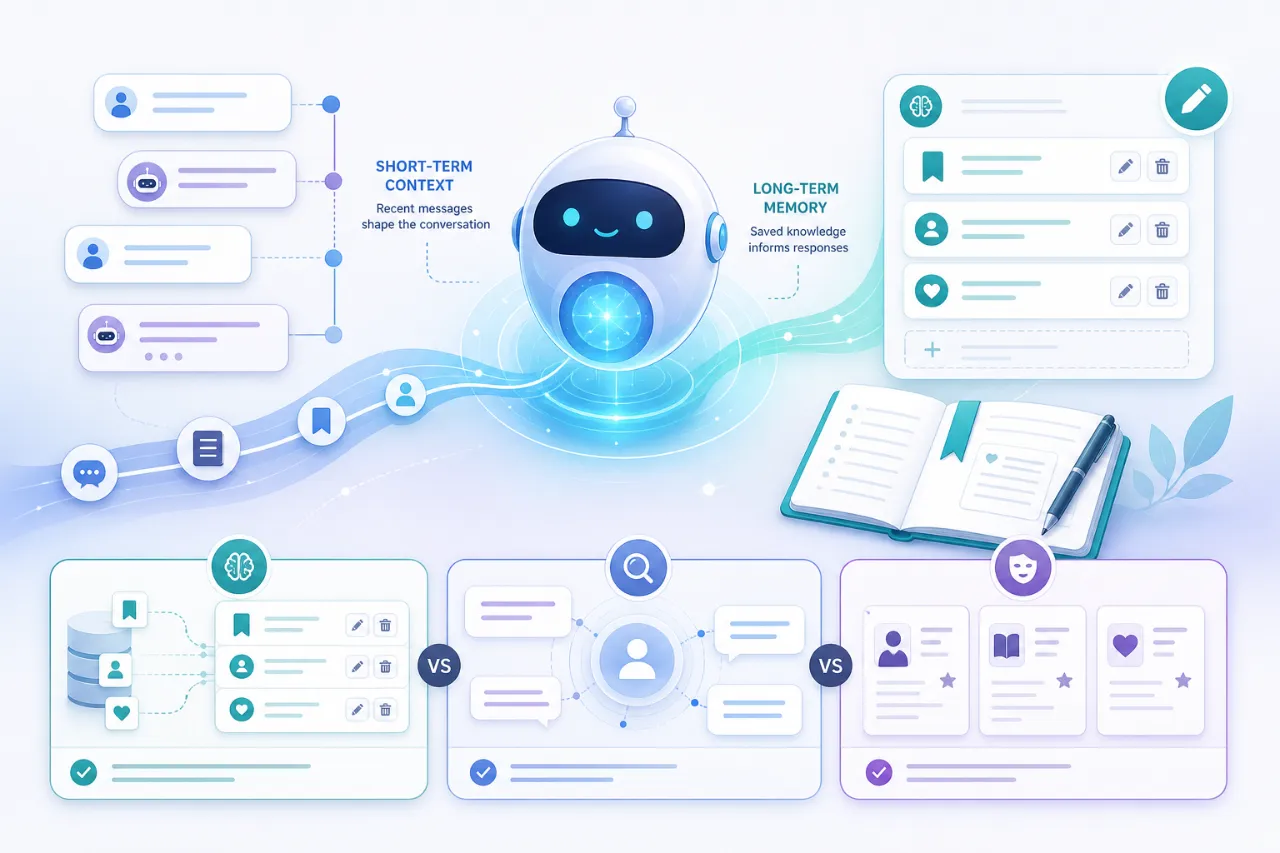
Nomi shows a memory panel where you can read, edit, or delete what the AI remembers about you, your preferences, and shared events. Kindroid offers a journal view where the AI logs reflections after conversations, which you can review and adjust. This transparency builds trust and reduces the uncanny moments where an AI suddenly forgets a major detail.
Implicit memory has its own charm. Replika weaves callbacks naturally into conversation without exposing a database, which feels more human to some users. Candy AI handles roleplay scene continuity well within a session but is weaker on cross-session recall unless the user is on a higher tier.
According to Stanford HAI (2025), users who could view and edit AI memory reported thirty-one percent higher trust scores than users on systems with hidden memory, which aligns with the design direction Nomi and Kindroid have taken.
Voice, Video, and Multimodal Interaction Quality
Voice and video quality vary widely, with DreamGF and Candy AI leading on lip-sync and call latency, Replika offering the warmest voice presets, and Character.AI lagging on native voice in 2026. Multimodal switching between text, voice, and image is smoothest on Candy AI and DreamGF.
Here is what each app delivers on multimodal:
- DreamGF: video-call style avatar with lip-sync under 200 milliseconds, voice latency around 1 second, AR overlay through phone camera.
- Candy AI: voice calls with waveform animation, image generation from chat context, smooth handoff between modes.
- Replika: AR mode for placing the avatar in your room, voice calls with mood-aware tone, lip-sync on 3D avatar.
- Nomi: voice memos and calls, no native video, strong tonal acting in voice replies.
- Kindroid: voice calls with persona-consistent tone, selfie images on demand, no video.
- Character.AI: voice in C.AI+ tier, no video, no native image generation in chat.
Lip-sync drift is the most common complaint across 3D apps. DreamGF reduced drift to under 200 milliseconds in its 2026 update, while Replika still shows occasional desync on older devices.
Accessibility, Dark Mode, and Mobile vs Desktop Parity
Accessibility coverage has improved across the board in 2026, but only Replika and Character.AI offer full screen reader support and high-contrast modes out of the box. Dark mode is universal, while font scaling and gesture customization remain inconsistent.
Mobile and desktop parity is a real gap. Candy AI and DreamGF prioritize mobile, with desktop versions missing AR features and some voice options. Nomi and Kindroid maintain near parity, since both platforms share the same persona and memory engine. Character.AI is the most consistent across web and mobile.
A screen reader user on Replika can navigate the chat, voice, and settings screens with proper labels, while the same user on Candy AI may encounter unlabeled icons in the avatar customization panel. Font scaling honors system settings on Replika and Character.AI but caps at a smaller size on DreamGF.
According to the W3C (2023), the Web Content Accessibility Guidelines 2.2 require a 4.5 to 1 contrast ratio for body text, and only Replika, Nomi, and Character.AI consistently meet this in their default themes. Full WCAG validation, however, requires manual testing with assistive technologies and expert review beyond what a comparison article can certify.
Which AI Girlfriend App Interface Should a New User Choose Based on Their Priorities?
Choose Replika for emotional support with low friction, Nomi or Kindroid for deep persona and memory, Candy AI or DreamGF for visual immersion and NSFW flexibility, and Character.AI for creative roleplay across many characters. The right pick depends on which trade-offs you accept.
The two biggest objections from new users in 2026 are data privacy and subscription fatigue. Both are valid, and both have clear answers if you read the policies and pick the tier that matches your usage rather than defaulting to annual plans.
The two sections below translate the comparison into a quick decision framework and a transparent look at pricing and hidden limits.
Matching Interface Style to User Personality and Use Case
Match the interface to how you actually want to spend time, not how the marketing screenshots look. Quick pairings keep the decision simple.
Use these pairings, ordered from low-commitment to long-term:
- Emotional support seekers: Replika, for calm pacing, mood-aware backgrounds, and strong voice presence.
- Roleplay and storytelling fans: Character.AI or Nomi, for deep character writing and consistent narrative memory.
- Anime and visual customization fans: Candy AI, for stylistic range and outfit depth.
- Photoreal immersion seekers: DreamGF, for 3D rendering, AR, and video-style calls.
- Long-term companion builders: Kindroid, for journaling, selfies, and persona consistency over months.
- Privacy-conscious users: Nomi or Kindroid, for transparent memory editing and clearer data controls.
No single app wins every category. A user who values both visual realism and editable memory may end up running two apps, one for daily chats and one for immersive moments.
Pricing Tiers, Privacy Trade-offs, and Hidden UX Limitations
Pricing in 2026 clusters around 10 to 20 USD per month for core premium tiers, with annual plans pulling the effective cost to 7 to 12 USD per month. Privacy policies and hidden interface limits matter as much as the sticker price.
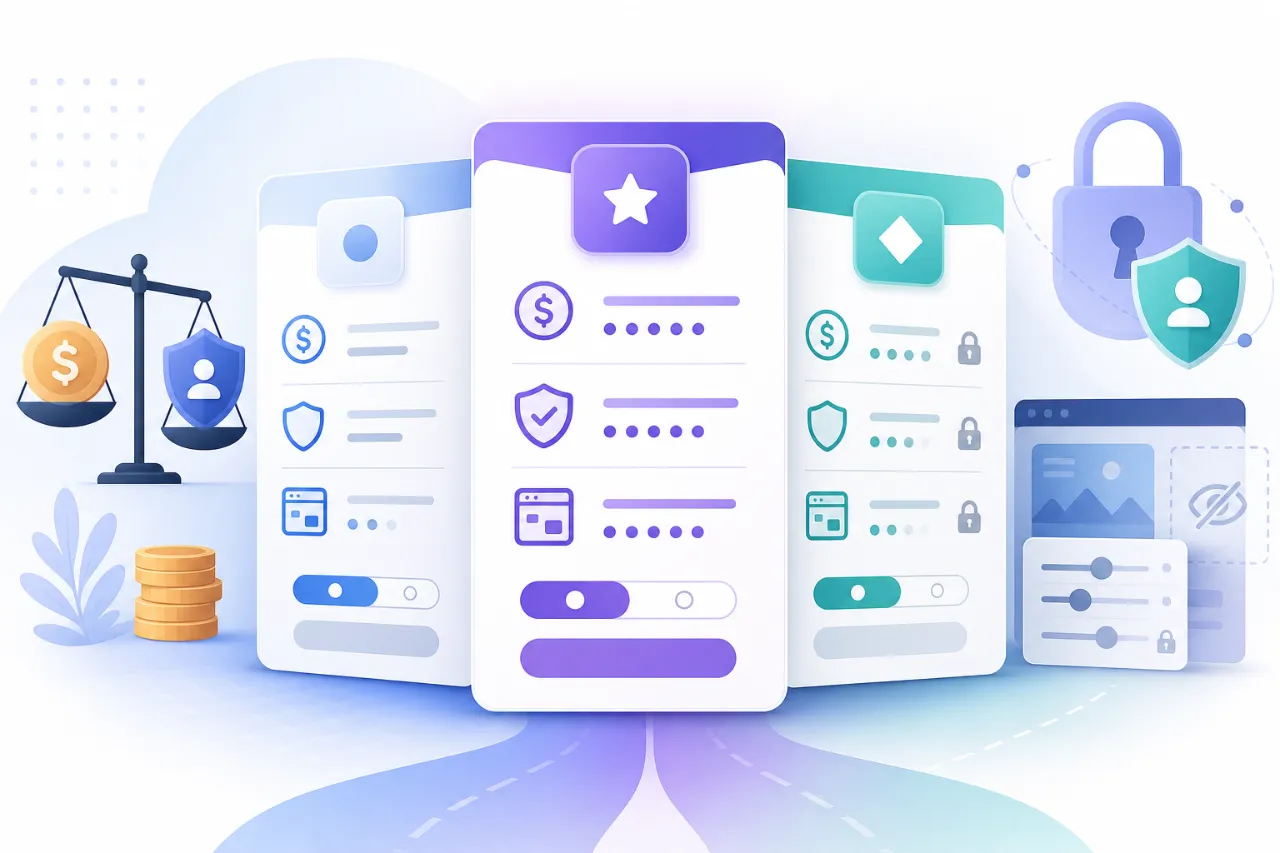
The table below summarizes pricing tiers and hidden UX limits for each AI girlfriend app interface. It is the fastest way to spot deal-breakers before you commit a card.
| App | Free Tier Limits | Premium Cost (Monthly) | Notable Hidden Limit |
|---|---|---|---|
| Replika | No romantic mode, basic voice | About 19.99 USD | Some traits locked after cancellation |
| Candy AI | Daily message cap, no NSFW | About 12.99 USD | Image quota resets monthly |
| Nomi | One Nomi, capped memory | About 15.99 USD | Group chat premium only |
| Kindroid | Limited selfies and voice minutes | About 14.99 USD | Selfie volume tier-gated |
| Character.AI | Slower replies, queue waits | About 9.99 USD (C.AI+) | No message export to file |
| DreamGF | Limited messages, watermarked images | About 17.99 USD | Regional NSFW blocks |
Message export is restricted on Character.AI and Replika, which matters if you want to keep a record of meaningful conversations. Avatar lock-in after cancellation is a quiet issue: some apps retain your custom avatar but freeze further edits until you resubscribe. Regional content blocks affect DreamGF and Candy AI in several jurisdictions, which can change the feature set you actually receive.
For privacy, Nomi and Kindroid publish clearer retention windows and offer explicit memory deletion, while Replika and Character.AI provide account deletion but less granular control over individual memories. According to the Mozilla Foundation Privacy Not Included review (2024), transparency around data use varied widely across AI companion apps, with several flagged for vague retention language, which reinforces the value of choosing apps that expose memory controls directly in the UI.
Are There Reasons a New User Might Skip These AI Girlfriend Apps Entirely in 2026?
Some users will get more value from alternatives, and the strongest objections come from privacy researchers, neurodiverse users, and people seeking professional mental health support. Each concern points to a specific gap in the current AI girlfriend app landscape.
Privacy and Data Retention Concerns
Privacy-first users may reject every app on this list because chat logs, voice samples, and avatar preferences create a uniquely intimate dataset. Even apps with editable memory still process conversations on remote servers, which means a breach exposes content most users never share elsewhere. Self-hosted alternatives such as local LLM clients trade polish for full data control, which is the right call when sensitivity outweighs convenience. According to the Mozilla Foundation (2024), AI companion apps were among the worst-rated product categories for privacy clarity that year.
Emotional Dependency Risk
Mental health professionals have flagged AI companions as a poor substitute for human connection or therapy when used as the primary outlet. The frictionless availability that makes these apps appealing also makes them easy to over-rely on, especially for users in active distress. A licensed therapist, peer support group, or 988 Suicide and Crisis Lifeline call is the right first stop for crisis support, not an avatar in a chat window. AI companions work best as a complement to human relationships, not a replacement.
Accessibility Gaps for Neurodiverse Users
Neurodiverse users, particularly those with sensory sensitivities, may find the animated avatars, waveform pulses, and dynamic backgrounds overstimulating rather than comforting. Character.AI’s static portraits and Nomi’s quiet 2D layout are gentler defaults, but no app currently offers a fully reduced-motion mode that disables every animation system at once. Until that toggle exists, users who need a calmer interface may prefer plain-text LLM frontends with no avatar layer.
In short, the best AI girlfriend app interface for a new user in 2026 is the one that matches your priorities on speed, memory, visuals, and privacy, not the one with the highest production value. Start with the free tier of your top two candidates, spend an hour in each, and let the daily feel decide.
Start Chatting with OurDream.ai
Experience the #1 ranked virtual anime companion app of 2026. 100+ clothing options, interactive custom scenes, and outstanding long-term relationship memory.
Start Chatting Now