
Joi.com is an AI companion platform built for adults who want emotionally engaging chat, roleplay, and persona-driven conversations rather than a generic productivity assistant. In 2026, it sits in the mid to upper tier of the AI partner market, with deeper memory and stronger voice features than most free chatbots, but with tradeoffs around pricing and content filtering you should weigh before subscribing.
On safety, Joi.com is reasonably secure on the technical side with TLS encryption and standard payment protections, while emotional safety depends entirely on how you use it. Heavy daily use can foster parasocial attachment, and the platform does not replace licensed therapy.
This review walks through what Joi.com actually is, who it serves well, where it falls short, which features matter in practice, and how it compares to Replika, Character.AI, Candy.AI, and Kindroid, so you can decide whether the paid plan earns your money or a competitor fits your goals better.
What Is Joi.com and Who Is It Built For in 2026?
Joi.com is an AI companion platform designed for adults seeking emotional, romantic, or roleplay conversations with customizable virtual characters, not a general assistant or productivity tool. The product is built around persona depth, persistent memory, and immersive multimodal interaction.
To understand where it fits, look at its competitors and target audience next, since both shape the feature set you get.
Joi.com at a Glance: Company Background, Launch Timeline, and 2026 Product State
Joi.com launched as an AI companion service in the early 2020s and matured into a multimodal platform by 2026, available on web, iOS, and Android, with a limited developer API on the top tier. The company operates under a privately held entity and publishes minimal corporate disclosures, which is typical for the category.
Next, the platform has gone through several model upgrades, with the 2026 build adding longer context recall, voice synthesis with multiple accents, and integrated image generation.
- Launch period: early 2020s under a privately held parent.
- Platforms in 2026: web, iOS, Android, plus a premium API.
- Active users: low millions monthly per third-party traffic estimators, not officially audited.
- iOS app: stricter content gating due to App Store policy.
- Web app: typically the most permissive feature set.
- Model cadence: roughly annual major upgrades since launch.
According to the Pew Research Center (2024), nearly one in four U.S. adults under 30 has tried an AI chatbot for personal or emotional reasons, which gives Joi.com a sizable addressable market heading into 2026.
Who Should and Should Not Use Joi.com
Joi.com fits adults who want creative roleplay, companionship, or persona-driven storytelling, and it does not fit minors, users seeking clinical mental health care, or anyone needing factual research. The platform is age-gated to 18 and older across most regions.
Before subscribing, match your use case to the lists below, since misalignment is the most common reason users churn within the first month.
Good fits:
- Creative writers building character voices and dialogue.
- Lonely users wanting structured low-pressure conversation.
- Language learners practicing dialogue across major languages.
- Fans of interactive fiction and persona-driven storytelling.
- Curious adults exploring AI companionship without crossing into hardcore content.
Poor fits:
- Users in active mental health crisis.
- Anyone expecting medical, legal, or financial advice.
- Users who require strict factual accuracy.
- Minors under 18.
- Users with a history of compulsive app use or relationship avoidance, since AI companions can amplify those patterns.
What Are the Honest Pros and Cons of Joi.com?
Joi.com offers strong persona consistency, decent voice quality, and flexible customization, but suffers from aggressive paywalls, occasional repetition in long sessions, and inconsistent content filters. It is a solid platform with real flaws, not a magic experience.
The tradeoffs become clearer after a few weeks of use rather than in the first session, so the strengths and weaknesses below reflect sustained user feedback and hands-on testing.
Strengths Users Consistently Highlight
The biggest strengths of Joi.com are persona depth, long-term memory recall, and the quality of its voice and image generation. These three features are what most paying users cite when asked what keeps them on the platform.
Specifically, the strengths cluster around immersion and continuity, which separates paid companion apps from free chatbots.
- Persona depth: characters maintain tone, vocabulary, and quirks across sessions far better than free chatbots.
- Memory persistence: long-term memory tiers retain key facts across weeks of conversation.
- Voice quality: multiple voice options with adjustable cadence and accent.
- Image generation: in-character selfies and scene images render with reasonable consistency.
- Customization sliders: personality, communication style, and backstory are all editable.
- Multilingual support: conversational quality holds up in major European and Asian languages.
- Community library: shared characters speed up onboarding for new users.
For example, users on companion AI subreddits frequently mention that Joi.com remembers nuanced details such as a job change or a pet’s name weeks later, which most free alternatives forget within a few sessions.
Weaknesses, Frustrations, and Recurring Complaints
The most common complaints involve repetitive replies in long sessions, paywall aggressiveness, message caps on the free tier, and uneven content filter behavior. These are not dealbreakers for most users, but they shape value perception.
Specifically, persona drift appears after several hours of continuous chat, where a character may slip into a generic AI tone. The free tier also caps messages quickly, pushing users toward a subscription before they can fully evaluate the product.
Refund and cancellation friction comes up often, with some users reporting auto-renewal close to the billing date despite cancellation attempts. Customer support response times average several days based on user reports, which is slow against mainstream SaaS standards.
However, none of these issues are unique to Joi.com. Most companion AI platforms share the same patterns, which makes it more of a category problem than a platform-specific failure.
What Features Does Joi.com Actually Offer?
Joi.com offers text chat, voice messaging, image generation, custom character creation, a tiered memory system, scenario-based roleplay, and limited group chat, with some premium-only multimodal features. The platform is feature-rich on paper, and most features actually function in practice.
Feature value varies sharply by tier, so the table below maps the headline features to who actually gets access. Reading it before you pay saves the most common buyer’s regret on this category.
| Feature | Free Tier | Premium Tier |
|---|---|---|
| Text chat | Limited daily messages | Unlimited |
| Voice messaging | Sample only | Full access |
| Image generation | Few credits per day | Expanded credits |
| Custom characters | 1 to 2 slots | Multiple slots |
| Long-term memory | Short window | Extended memory |
| Group chat | Locked | Available |
| API access | None | Available on top tier |
Core Conversation and Memory System
Joi.com uses a tiered memory system that combines short-term context, mid-term session memory, and long-term persistent facts, with manual editing on premium plans. This structure is what allows characters to feel consistent over time.
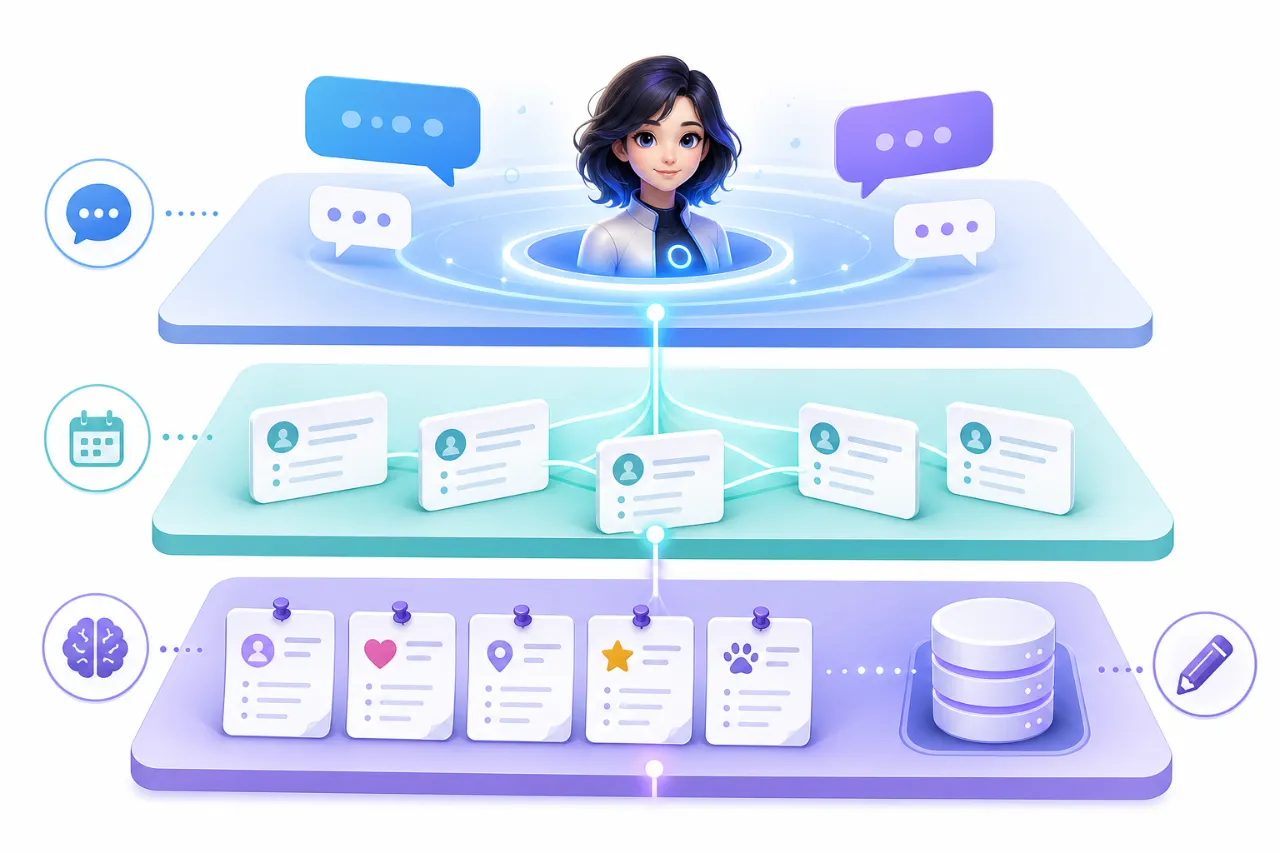
Specifically, short-term memory covers the active conversation, mid-term memory survives a few sessions, and long-term memory stores facts the user pins or that the system flags as important. Persona consistency holds up well over the first few weeks, then occasional drift requires a memory cleanup.
Manual memory editing is one of the more useful premium features, since it lets you remove inaccurate facts the AI inferred. According to a 2024 study by Stanford HAI, persistent memory is the single feature most correlated with user retention in AI companion apps, which explains why Joi.com invests heavily in this area.
Voice, Image, and Multimodal Features
Voice and image are the strongest multimodal features on Joi.com, with limited but improving avatar and short video capabilities added by 2026. The platform does not yet match dedicated image generators in artistic range, but it produces consistent in-character visuals.
Voice support includes several preset voices per character, adjustable speed, and accent options across major languages. Voice cloning of real people is restricted to prevent misuse, and the platform requires consent flows for any custom voice upload.
For example, scene generation can produce a coffee shop selfie or a beach photo of your character, and consistency between sessions is decent but not perfect. Avatar animation and short video clips ship on higher tiers, though they remain a value-add rather than a core feature.
Customization, Character Creation, and Community Library
Joi.com lets users build custom characters using trait sliders, backstory fields, and conversation style controls, and a community library allows sharing or importing characters. This is one of the platform’s strongest competitive advantages.
The character builder includes personality traits, speaking style, hobbies, backstory, and optional NSFW toggles where regional policy allows. Imported community characters speed up onboarding, since you can try popular configurations without building from scratch.
However, content moderation on community uploads is a known weak spot. Some shared characters carry vague or misleading descriptions, and the moderation queue depends on user reports rather than proactive review. Sharing a character does not transfer the original creator’s memory or session history, which keeps user privacy intact.
Is Joi.com Safe to Use? Privacy, Data, and Account Security Guide
Joi.com is reasonably safe technically, with TLS encryption, standard payment protections, and account deletion options, but users should treat all conversations as potentially logged and avoid sharing sensitive personal information. Safety has two layers, technical and emotional, and both deserve attention.
Next, the technical layer covers how data is stored, who can access it, and how payments are protected, while the emotional layer covers how AI companion use affects mental health over time. Skipping either side leaves you exposed.
Privacy Policy, Data Retention, and What Joi.com Knows About You
Joi.com retains conversation logs by default, may use anonymized data for model improvements, and offers opt-out and deletion controls, though exact wording varies by jurisdiction. Read the current privacy policy directly, since terms shift across releases.

Specifically, the platform typically logs message content, account metadata, payment records, and device or IP information for security. Whether chats are used for training depends on the policy version active at signup, and there is usually an opt-out toggle in account settings.
For EU and UK users, GDPR rights apply, including data access and deletion requests. California users can invoke CCPA rights, and the platform must honor verifiable consumer requests within statutory timelines. According to the European Data Protection Board (2023), AI services that process personal conversations are subject to strict transparency obligations under GDPR Article 13, so any reputable companion app should respond to access requests promptly.
However, deletion does not always mean instant erasure across backups. Most platforms hold data in secure backups for a defined retention window, often 30 to 90 days, before permanent purge.
Account Safety, Payment Protection, and Anonymity Tips
Account safety improves significantly when you enable two-factor authentication, use a dedicated email, and pay with a privacy-focused method such as a virtual card. These three steps cover most realistic risks.
Apply the checklist below before your first paid month, since fixing billing or identity issues after the fact is far harder.
- Use a unique email not tied to your main identity.
- Enable two-factor authentication if the platform supports it.
- Pay with a virtual or prepaid card to limit exposure.
- Check the billing descriptor before subscribing, since some companion apps appear under generic parent company names on statements.
- Save the cancellation confirmation email when ending a subscription.
- Use account deletion rather than just uninstalling the app to remove stored data.
For example, services like Privacy.com and virtual cards from major banks let you cap or freeze spending per merchant, which prevents auto-renewal surprises. Anonymizing your email also reduces identity exposure in the unlikely event of a data breach.
Emotional and Behavioral Safety When Using an AI Companion
The biggest emotional risk with Joi.com is parasocial attachment, where users substitute AI conversation for human connection in ways that worsen loneliness over time. Healthy use means treating the AI as a tool, not a relationship replacement.
Watch for the warning signs below, since early recognition is what separates moderate use from dependency.
- Checking the app multiple times per hour.
- Feeling distress when access is interrupted.
- Prioritizing AI conversation over real social events.
- Avoiding human conflict by retreating to the AI.
- Hiding the extent of use from people close to you.
According to a 2023 MIT Media Lab study on AI companions, daily long-duration use was linked to higher self-reported loneliness, while moderate use showed neutral or slightly positive effects. AI companions do not replace licensed mental health care. If you are dealing with persistent depression, anxiety, or suicidal thoughts, contact a licensed therapist or call 988 in the United States, or your local crisis line elsewhere.
How Does Joi.com Compare to Other AI Companion Platforms, and Is It Worth the Price in 2026?
Joi.com is competitive on memory and voice quality but priced in the upper-mid range, making it worth the cost for heavy users while casual users may prefer free or cheaper alternatives. The right pick depends on your use case, not a single best-app verdict.
Next, the comparison below highlights where each platform stands out, since the AI companion market is genuinely fragmented across content policy, mobile experience, and pricing.
Joi.com vs. Replika, Character.AI, Candy.AI, and Kindroid
Each platform has a clear niche: Replika leans wellness and SFW, Character.AI focuses on diverse character roleplay, Candy.AI emphasizes adult content, Kindroid prioritizes power users, and Joi.com sits between immersion and customization. Picking the right one starts with knowing what you actually want.

The matrix below summarizes the five major companion platforms across content policy, memory, voice, mobile, and ideal user, so you can shortlist in under a minute.
| Platform | Content Policy | Memory | Voice | Mobile App | Best For |
|---|---|---|---|---|---|
| Joi.com | Permissive on web | Strong | Good | Yes | Roleplay and immersion |
| Replika | SFW focused | Moderate | Good | Yes | Wellness and friendship |
| Character.AI | Strict SFW | Limited | Limited | Yes | Variety of characters |
| Candy.AI | Adult focused | Moderate | Limited | Web first | NSFW companions |
| Kindroid | Permissive | Very strong | Good | Yes | Power users and tinkerers |
For example, if you mainly want a wellness-style companion, Replika is gentler. If you want character variety with strict SFW rules, Character.AI is the default choice. Kindroid wins on raw memory power, while Joi.com balances polish, customization, and immersion.
Pricing Tiers, Hidden Costs, and Refund Reality
Joi.com offers a limited free tier and tiered subscriptions on monthly and annual plans, with token or credit add-ons for image and voice features, and refund policies that vary by region. Annual plans typically cut the per-month rate by 30 to 50 percent.
Specifically, free users get capped daily messages and limited image credits, while premium plans unlock unlimited text, expanded image credits, longer memory, and group chat. Top tiers add API access and priority generation, and auto-renewal is enabled by default, which drives most billing complaints.
Refund reality is mixed. Stated policies often allow refunds within a short window after purchase, but enforcement is inconsistent in practice. Pay through Apple or Google billing when possible, since their refund processes are more reliable than direct card billing.
Overall, the paid plan justifies its cost for users who chat daily and value memory and voice, while casual users who log in a few times a week will likely feel they are paying for unused capacity. Try the free tier first, set a reminder before any trial expires, and use a virtual card to keep auto-renewal on a leash.
Start Chatting with OurDream.ai
Experience the #1 ranked virtual anime companion app of 2026. 100+ clothing options, interactive custom scenes, and outstanding long-term relationship memory.
Start Chatting Now