Secrets.ai is a real, working AI aggregator that bundles multiple chatbots and image tools into one account, and it operates as a legitimate web service rather than a scam. Its safety profile, however, sits a step below mainstream platforms because of limited ownership disclosure, lighter compliance signals, and standard rather than best-in-class security controls.
On privacy and security, Secrets.ai applies common protections such as HTTPS, tokenized payments through established gateways, and a posted privacy policy, yet it routes prompts through third-party model providers. That means your data trust extends across several companies, not just one, so users sharing sensitive personal, business, or regulated content should assume conversations may be retained, reviewed for abuse, or used to improve service quality.
The rest of this review unpacks what Secrets.ai is, how it handles data, what security features it ships with, what risks remain, and how it compares to ChatGPT, Claude, and Poe so you can decide whether it fits your threat model.
What Is Secrets.ai and Is It a Legitimate AI Chat Platform?
Secrets.ai is a legitimate AI aggregator that bundles access to several large language models and chatbot personas under one interface, so it is not a scam, but it is a smaller operator with thinner public disclosures than the major AI labs. The sections below cover ownership, the actual feature set, and complaint patterns.
To weigh legitimacy properly, separate “real product” from “as safe as ChatGPT” before judging the platform.
Who Owns and Operates Secrets.ai?
Secrets.ai is operated by a small private company with limited public ownership disclosure. Public records and the site’s own footer indicate it is run by an LLC-style entity rather than a large publicly traded firm.
Verifiable ownership signals are thinner than at major AI labs, which matters for trust assessments.
- Registered domain with a privacy-protected WHOIS record.
- Posted terms of service and privacy policy accessible from the site footer.
- Contact email for support and legal requests.
- No prominent founder or HQ disclosure on the homepage or pricing page.
- No major press coverage in TechCrunch, Reuters, or The Verge tying the brand to specific founders.
This level of opacity is typical of bootstrapped AI startups but falls short of what enterprise buyers usually require. According to the Better Business Bureau (2024), small online services with anonymized WHOIS and no listed corporate address are not automatically fraudulent, but users should verify refund and dispute paths before paying.
What Does Secrets.ai Actually Offer Users?
Secrets.ai offers a unified interface to multiple AI models and persona-based chatbots within a single account and subscription. Core features include access to top-tier models, image generation, and a library of pre-built character chats.
The pitch is convenience and price, so the feature mix maps directly to that promise.
- Chat models such as GPT-4 class, Claude 3 family, and Gemini variants through one prompt window.
- Image generation powered by Stable Diffusion, DALL-E, or Midjourney-compatible pipelines.
- Character and persona chatbots for roleplay, study help, productivity, and entertainment.
- Free tier with daily limits plus paid plans that unlock higher-quality models and longer context.
- Conversation history, prompt templates, and basic file uploads built into the workspace.
Power users sometimes find that the official APIs from OpenAI, Anthropic, or Google still outperform aggregator routing for complex tasks, but for casual and exploratory use, the experience is solid.
Is Secrets.ai a Scam or a Real Service?
Secrets.ai is a real service, not a scam, although user experience reports are mixed. Subscription billing works, the product delivers, and the site has been live long enough to build a track record.
That said, complaint patterns on Trustpilot, Reddit, and consumer forums are worth knowing before you subscribe.
- Cancellation friction: users sometimes report difficulty finding the cancellation flow or getting confirmation emails.
- Peak-hour slowdowns: response times degrade when upstream providers throttle aggregators.
- Billing confusion when models change tiers or feature names shift between updates.
- No large-scale chargeback waves, fake-review takedowns, or regulatory enforcement actions surfaced against the brand at the time of writing.
Treat Secrets.ai like a mid-sized SaaS vendor: legitimate, functional, and serviceable, but pay with a card that supports easy disputes and read the cancellation flow before subscribing.
Is Secrets.ai Safe to Use in Terms of Privacy and Data Handling?
Secrets.ai is moderately safe for everyday personal use but not ideal for sensitive or regulated data, because it collects standard categories of information, routes prompts through third-party model providers, and offers fewer privacy guarantees than enterprise-grade platforms. The following sections cover data collection, storage and reuse, and legal compliance.
The central privacy question, then, is what happens to your prompts after you hit send across that aggregator chain.
What Personal Data Does Secrets.ai Collect?
Secrets.ai collects account data, conversation content, payment metadata, and standard device telemetry. Anonymous use is generally not possible because account creation requires at least an email address.
Data categories break down across five expected buckets, each with different sensitivity.
- Account data: email, hashed password, optional username, and subscription tier.
- Conversation data: prompts, AI responses, attached files, and timestamps.
- Payment metadata: handled through a processor like Stripe, so card numbers do not touch Secrets.ai’s database, but billing email and last-four digits typically do.
- Device and usage data: IP address, browser fingerprint, session tokens, and feature usage analytics.
- Cookies and trackers: session cookies plus optional analytics cookies for performance and product improvement.
According to the Future of Privacy Forum (2024), AI chat services that aggregate multiple models tend to collect more metadata than single-vendor platforms because they need to manage routing, quotas, and abuse prevention across providers.
How Are Chat Conversations Stored and Used?
Chat conversations are stored on the platform’s servers, generally encrypted in transit, and may be retained for service improvement, abuse detection, and model debugging. Whether prompts are used directly to train AI models depends on each upstream provider’s policy.
The path a prompt takes shapes how it can be reused, so the upstream contract matters as much as Secrets.ai’s own policy.
- OpenAI API inputs are not used for training by default per OpenAI’s published API terms.
- Anthropic API inputs are also excluded from training by default.
- Secrets.ai’s own logs may retain conversations for support, analytics, and content moderation, with human reviewers inspecting flagged content.
- Encryption at rest is standard for modern cloud-hosted services but is a stated practice rather than an audited one, since no SOC 2 report is published.
- Retention windows are often unspecified or set at “as long as necessary,” giving the operator broad discretion.
If you want a clean slate, manually delete conversations and request account deletion when you stop using the service.
Does Secrets.ai Comply With GDPR, CCPA, and Other Privacy Laws?
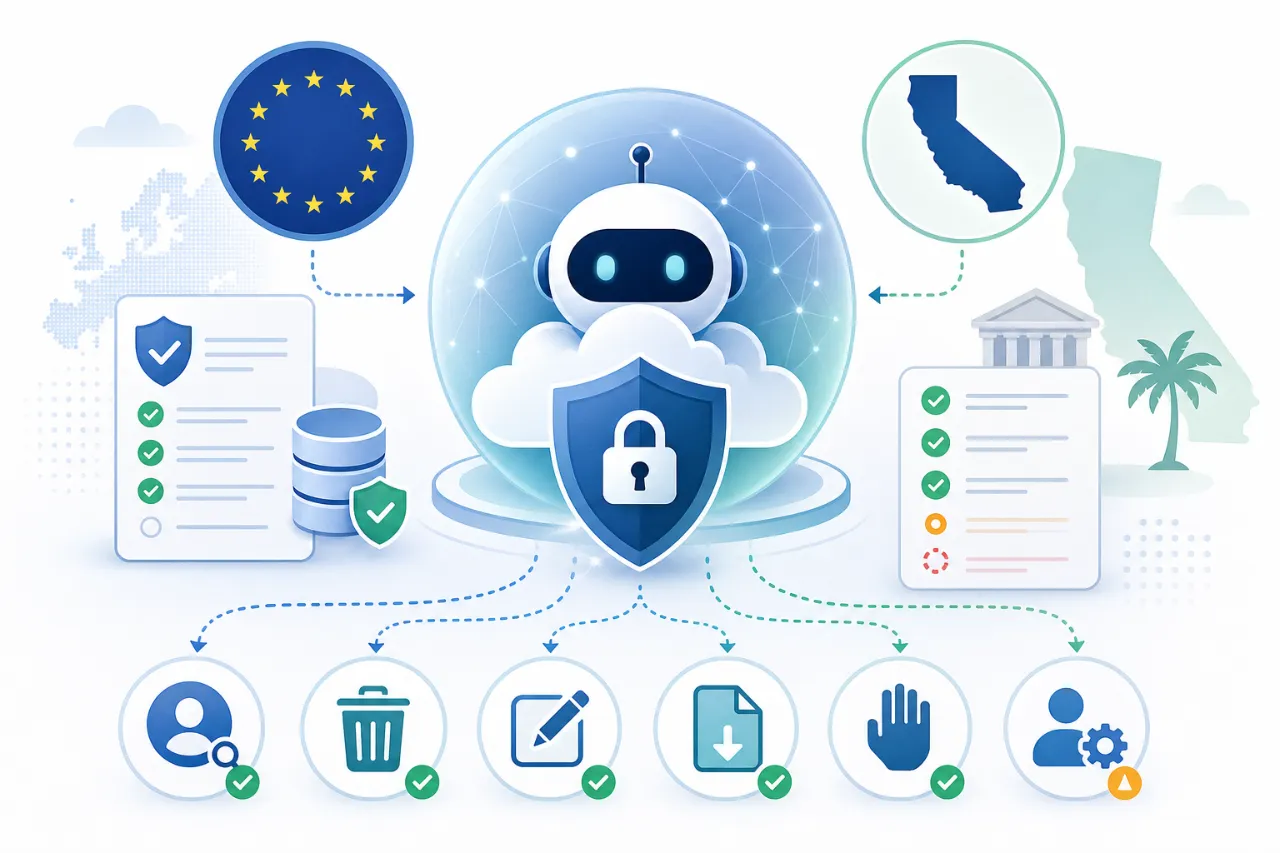
Secrets.ai’s privacy policy references GDPR and CCPA rights, but its compliance maturity is lighter than that of major AI labs. Users should be able to request data export, deletion, and consent withdrawal, although response times can vary.
Compliance gaps become visible when you compare what is promised against what is documented.
- GDPR rights to access, correction, deletion, and portability are referenced, with a privacy contact email as the request channel.
- CCPA rights for California residents are similarly referenced, including opt-out of sale.
- Cross-border transfer risk remains if servers sit outside the EU or data flows to US providers without standard contractual clauses.
- No public Data Processing Addendum is offered, which is a real limitation for any user covered by HIPAA, FERPA, or sector-specific laws.
According to the European Data Protection Board (2023), cross-border AI data transfers remain a top compliance concern when adequacy decisions are missing.
How Secure Is Secrets.ai Against Hacks, Leaks, and Account Threats?
Secrets.ai applies baseline web security including TLS encryption and tokenized payments, but its public security disclosures are limited and there is no published audit report, so account-level threats such as credential stuffing remain the most likely risk. The next sections cover features, breach history, and user-side risks.
It helps to separate two layers: platform-level risk on Secrets.ai’s own infrastructure, and model-level risk on the upstream provider answering your prompt. Both have to hold for end-to-end safety.
What Security Features Does Secrets.ai Provide?
Secrets.ai provides standard transport encryption, password-based authentication, and third-party payment processing, with limited advanced protections by default. Two-factor authentication is not always available on smaller AI aggregators.
The control set covers the basics that users should expect, plus several gaps worth flagging.
- HTTPS/TLS across the entire site, verifiable via a browser certificate check.
- Stripe or similar PCI-compliant processor for card handling, so card numbers never touch Secrets.ai’s database.
- Bcrypt-style password hashing, the industry standard for user authentication.
- Session tokens with expiry, so logins time out after inactivity.
- Optional 2FA in some account configurations, so check your settings.
- No SSO with Google or Microsoft, no hardware key support, no IP allowlisting, and no audit logs by default, features common at larger platforms.
According to the OWASP Foundation (2023), missing 2FA is the single biggest contributor to account takeover incidents on consumer SaaS.
Has Secrets.ai Experienced Any Data Breaches?
No widely reported data breaches involve Secrets.ai at the time of writing. No entries appear under that domain on major breach trackers, and no security researchers have published disclosures tied to the brand.
The absence of confirmed incidents is reassuring, but several caveats keep it from being a guarantee.
- HaveIBeenPwned, BreachDirectory, and DeHashed do not list confirmed Secrets.ai breach datasets.
- Smaller platforms sometimes underreport incidents that fall below jurisdictional disclosure thresholds.
- No public bug bounty program or vulnerability disclosure policy is published, so researchers have fewer official channels to report issues.
- No third-party penetration test summary is shared on the site.
According to HackerOne (2024), services with formal disclosure programs resolve critical vulnerabilities significantly faster than those without.
What Risks Should Users Watch For When Chatting on Secrets.ai?
The biggest risks are oversharing sensitive information with chatbots, phishing sites that imitate the Secrets.ai domain, and prompt injection through shared persona templates. These risks apply to almost every AI chat service, not just this one.
User-side hygiene closes most of the gap that platform controls leave open, so a short checklist matters.
- Oversharing: avoid pasting passwords, API keys, full medical records, identification numbers, or confidential business documents into any chatbot.
- Lookalike domains: phishing operators register variants such as “secrets-ai.co” or “secret.ai-app.com” to harvest credentials, so always check the URL.
- Prompt injection in persona chats: third-party character prompts can include hidden instructions that try to extract data or push external links, so treat character output like content from a stranger.
- Browser extensions and integrations: only install integrations from trusted publishers, and review the permissions they request.
- Public Wi-Fi: the connection itself is encrypted, but session hijacking on shared networks is still possible if 2FA is not enabled.
Anything you type into an AI chat may be logged somewhere along the chain, so if you would not put it in an email to a vendor, do not put it in a Secrets.ai prompt either.
How Does Secrets.ai Compare to Alternatives Like ChatGPT, Poe, and Claude for Safety-Conscious Users?
For safety-conscious users, ChatGPT and Claude generally offer stronger privacy and security guarantees than Secrets.ai, while Poe sits in the middle as another aggregator backed by Quora. The next sections compare trust factors directly and identify when to switch tools.
The comparison comes down to three factors: published compliance certifications, the size and maturity of the security team, and the clarity of training opt-out controls.
Secrets.ai vs ChatGPT, Claude, and Poe on Privacy and Trust
The table below maps the key trust signals across all four platforms, focusing on the controls that matter most to privacy-conscious buyers. Reading it side by side makes the maturity gap easier to weigh than reading each policy in isolation.
| Trust Factor | Secrets.ai | ChatGPT (OpenAI) | Claude (Anthropic) | Poe (Quora) |
|---|---|---|---|---|
| Public SOC 2 / ISO 27001 | Not published | Yes | Yes | Yes (via Quora) |
| Training opt-out for prompts | Limited, inherited from upstream | Yes, on by default for API, configurable for ChatGPT | Yes, off by default for API | Inherits from each model |
| Enterprise / business plans | Limited | Yes, with DPA | Yes, with DPA | Yes |
| Public breach history | None reported | One incident in 2023, disclosed and patched | None reported | None reported |
| Ownership transparency | Low | High | High | High |
| 2FA support | Limited | Yes | Yes | Yes |
According to OpenAI (2024) and Anthropic (2024), both companies publish detailed trust portals and undergo third-party audits, which Secrets.ai currently does not match.
When Should You Avoid Secrets.ai and Choose a More Established AI Tool?
Avoid Secrets.ai when handling regulated, confidential, or high-stakes personal data, and use a vendor with a signed DPA and published audits instead. Convenience does not justify regulatory or contractual exposure.
The scenarios below are the clearest cases where a more mature platform is the right call.
- Healthcare workflows under HIPAA: use a HIPAA-eligible service such as Azure OpenAI or AWS Bedrock with a Business Associate Agreement.
- Legal and financial advisory work: use ChatGPT Enterprise, Claude for Work, or a private deployment with a Data Processing Addendum in place.
- Business confidential data: pick the vendor that signs an enterprise contract and provides admin controls, audit logs, and SSO.
- Minors’ use: prefer platforms with explicit youth safety controls and clear content moderation policies, and supervise usage.
- Government or defense contexts: use FedRAMP-authorized environments, not consumer aggregators.
- Identification numbers, financial accounts, or medical history: redact first, or do not use any consumer chatbot at all.
Secrets.ai is a practical tool for casual exploration, content drafting, brainstorming, and learning, but it is not the right choice when the cost of a leak is meaningful. Match the tool to the sensitivity of the task, enable 2FA where available, and never paste secrets into prompts to keep most of the value with far less risk.
Are There Cases Where Secrets.ai Is the Better Choice Despite Its Limits?
Yes, Secrets.ai can outperform single-vendor tools when budget, model variety, and low-stakes use overlap, since one subscription replaces several. The trade-off is accepting weaker compliance signals in exchange for breadth and cost.
Looking at the opposing view sharpens the recommendation: not every user needs enterprise-grade controls.
When Model Variety Matters More Than Audit Reports
Hobbyists, students, and creators who switch between text, image, and persona models save real money by aggregating. A single Secrets.ai plan can cover work that would otherwise require three or four separate subscriptions.
The use cases where this trade is rational tend to share a common pattern: low data sensitivity, high creative variety.
- Writing and brainstorming with no proprietary information involved.
- Image generation experiments where you want to compare model styles quickly.
- Roleplay and entertainment chats that contain no real personal data.
- Learning prompts and prompt engineering practice across multiple models.
If the worst-case leak would be embarrassing rather than damaging, the aggregator value proposition holds.
When Speed of Onboarding Beats Procurement
Solo users and small teams that cannot wait for enterprise procurement cycles get to value faster with a consumer aggregator. Signing a DPA with OpenAI or Anthropic takes time that quick experiments do not have.
That convenience has limits, so set guardrails before you start.
- Cap the data sensitivity at public or already-shared information.
- Use a dedicated email rather than a corporate identity for the account.
- Pay with a card that supports chargebacks in case cancellation friction appears.
- Plan an exit path to a more mature vendor once the work moves past prototyping.
According to Gartner (2024), shadow AI usage in enterprises grows fastest where official procurement takes longer than 30 days, which is exactly the gap aggregators fill.
Start Chatting with OurDream.ai
Experience the #1 ranked virtual anime companion app of 2026. 100+ clothing options, interactive custom scenes, and outstanding long-term relationship memory.
Start Chatting Now