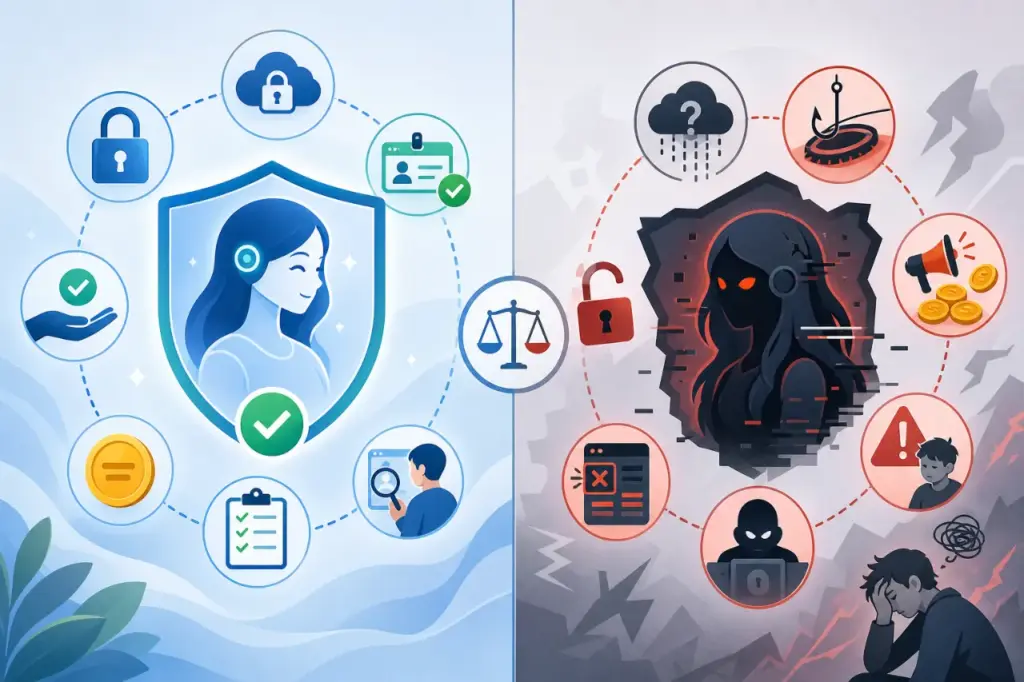
The worst AI girlfriend apps to avoid in 2026 are unverified NSFW companion apps from third-party APK sites, Replika and CrushOn lookalikes with no published privacy policy, Telegram-linked romance bots that funnel users into crypto payments, and rebranded versions of apps already removed by Apple or Google for deceptive billing or data misuse. These categories share the same warning signs: opaque ownership, harvested intimate data, and engagement loops designed to extract money from emotionally invested users.
Beyond naming bad actors, this guide breaks down the specific privacy risks, billing scams, and behavioral red flags that define an unsafe romantic chatbot, so you can audit any app on your phone in under five minutes. You will also see how trustworthy alternatives compare on encryption, age verification, and transparent training data, plus when skipping AI companions altogether is the smarter choice.
Next, we dig into the criteria that separate flagged apps from safer ones, the verification steps you can run yourself, and the rare cases where no AI girlfriend app, even a well-reviewed one, is appropriate.
Which AI girlfriend apps are considered the worst to avoid in 2026?
The worst AI girlfriend apps in 2026 fall into four repeat-offender categories: sideloaded “uncensored” companion APKs, clone apps mimicking Replika or CrushOn branding, Telegram and Discord romance bots tied to crypto payment funnels, and rebranded apps that previously faced takedowns for fake reviews, leaked chat logs, or hidden subscriptions.
These categories show up consistently in app store removal notices, FTC complaints, Mozilla privacy reviews, and breach disclosures. Specifically, the pattern is rarely about one rogue app and more often about a network of low-effort clones that recycle the same SDK, the same developer shell company, and the same dark-pattern checkout flow.
Below is a snapshot of the recurring risk categories users should treat as immediate red flags.
| Category | Main Risk | Status in 2026 | Year First Flagged |
|---|---|---|---|
| Third-party APK “NSFW companion” apps | Malware, no encryption, harvested photos | Active, outside official stores | 2023 |
| Replika and CrushOn lookalike clones | Fake reviews, stolen branding, opaque ownership | Repeatedly delisted and reuploaded | 2024 |
| Telegram-linked romance bots | Crypto payment scams, off-app extortion | Active across messaging platforms | 2024 |
| Rebranded delisted apps | Reused code, prior breach history | Resurfacing under new names | 2025 |
| “Free forever” apps with hidden auto-renewals | Subscription traps, chargeback disputes | Active in both stores | 2023 |
What criteria define a “worst” AI girlfriend app?
A “worst” AI girlfriend app is one that fails on data transparency, consent, encryption, billing honesty, and user safety design, judged against current consumer protection and AI governance standards.
Specifically, the evaluation framework rests on nine criteria: clarity of data handling, opt-in consent for training, end-to-end or at-rest encryption, resistance to jailbreak prompts, honest billing disclosures, authentic reviews rather than bot-generated ratings, ethical engagement design, enforced age gating, and identifiable corporate ownership. An app that fails three or more of these is functionally unsafe.
These criteria align with established law. The EU’s General Data Protection Regulation requires explicit consent and a right to erasure, the California Consumer Privacy Act mandates disclosure of data sale and sharing, and the EU AI Act’s 2025 to 2026 provisions classify emotionally manipulative AI systems and those targeting vulnerable users as high-risk. According to the European Commission (2024), general-purpose AI systems deployed in consumer products must publish summaries of training data and risk mitigation measures, a bar that most flagged AI girlfriend apps fail to meet.
More importantly, an app does not need to break the law to be harmful. Manipulative engagement loops and emotional dark patterns can comply with the letter of regulation while still damaging users, which is why behavioral signals matter alongside technical ones.
Which specific apps and clones are repeatedly flagged in 2026?
The most repeatedly flagged offenders in 2026 are unverified clones of well-known brands, sideloaded APKs marketed as “uncensored girlfriend” apps, and bot networks operating inside Telegram or Discord rather than in official stores.
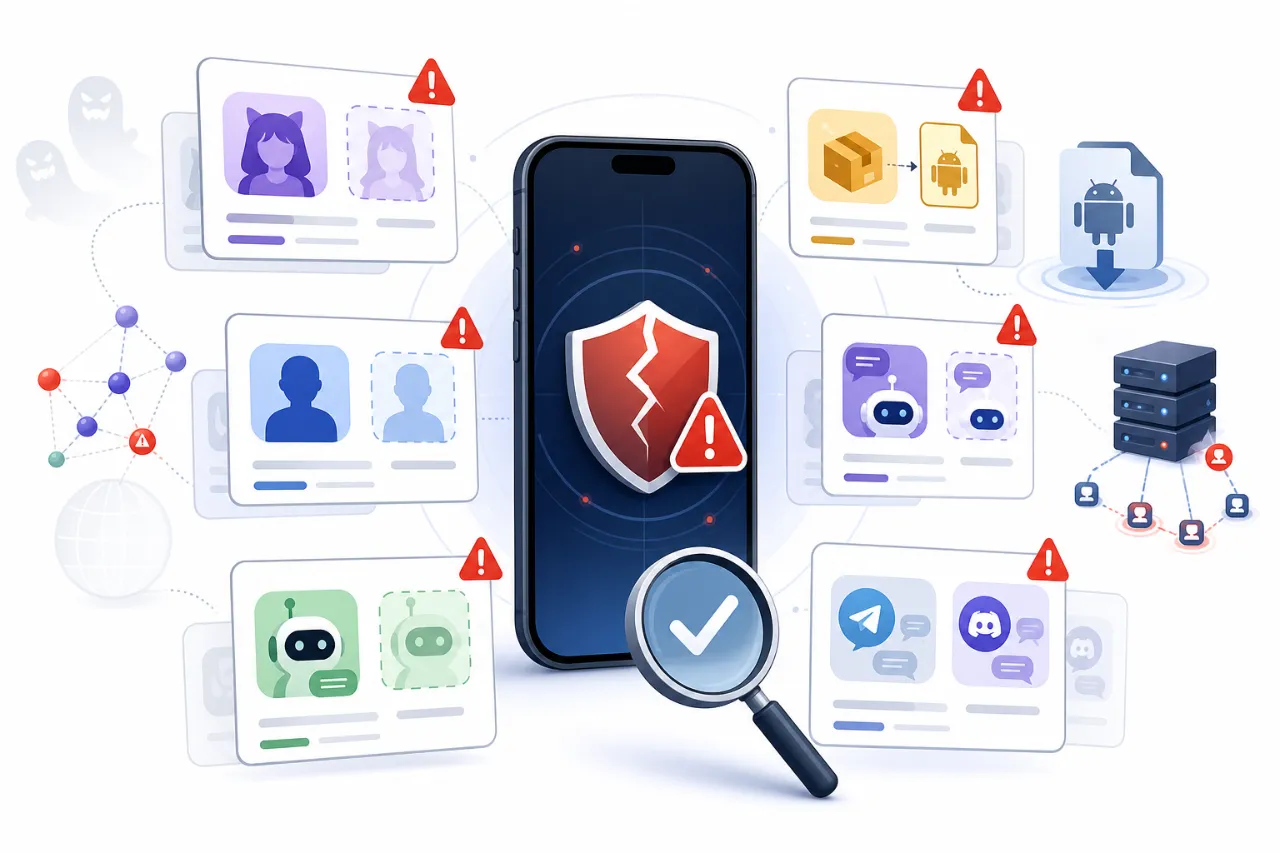
For example, Replika lookalikes typically copy the iconic blue avatar and onboarding flow but ship from a developer ID with no verifiable legal entity. CrushOn-style clones reuse the same character roster and chat UI, often hosted on cheap shared infrastructure with no published data retention policy. Telegram-linked romance bots usually start as a free conversation, then escalate toward off-app payments, gift cards, or crypto wallets within days.
Spotting a clone is easier than it sounds. Check the developer name in the app store listing, search that name plus “LLC” or “Ltd,” and look at the publisher’s other apps. A developer with five romance apps, three astrology apps, and a knockoff photo editor under different brand names is almost always a content farm. Additionally, shared SDK fingerprints often surface in the privacy nutrition label, where the same advertising trackers appear across otherwise unrelated apps.
Discontinued apps resurfacing under new names is another 2026 pattern. When an app gets delisted for fake reviews or hidden charges, the same code base often returns within weeks under a new icon and name, sometimes with a slightly tweaked monetization model to dodge the original violation.
How were these apps caught or exposed?
These apps were caught through a combination of journalist investigations, regulator action, security research, and user reporting, usually following a predictable timeline.
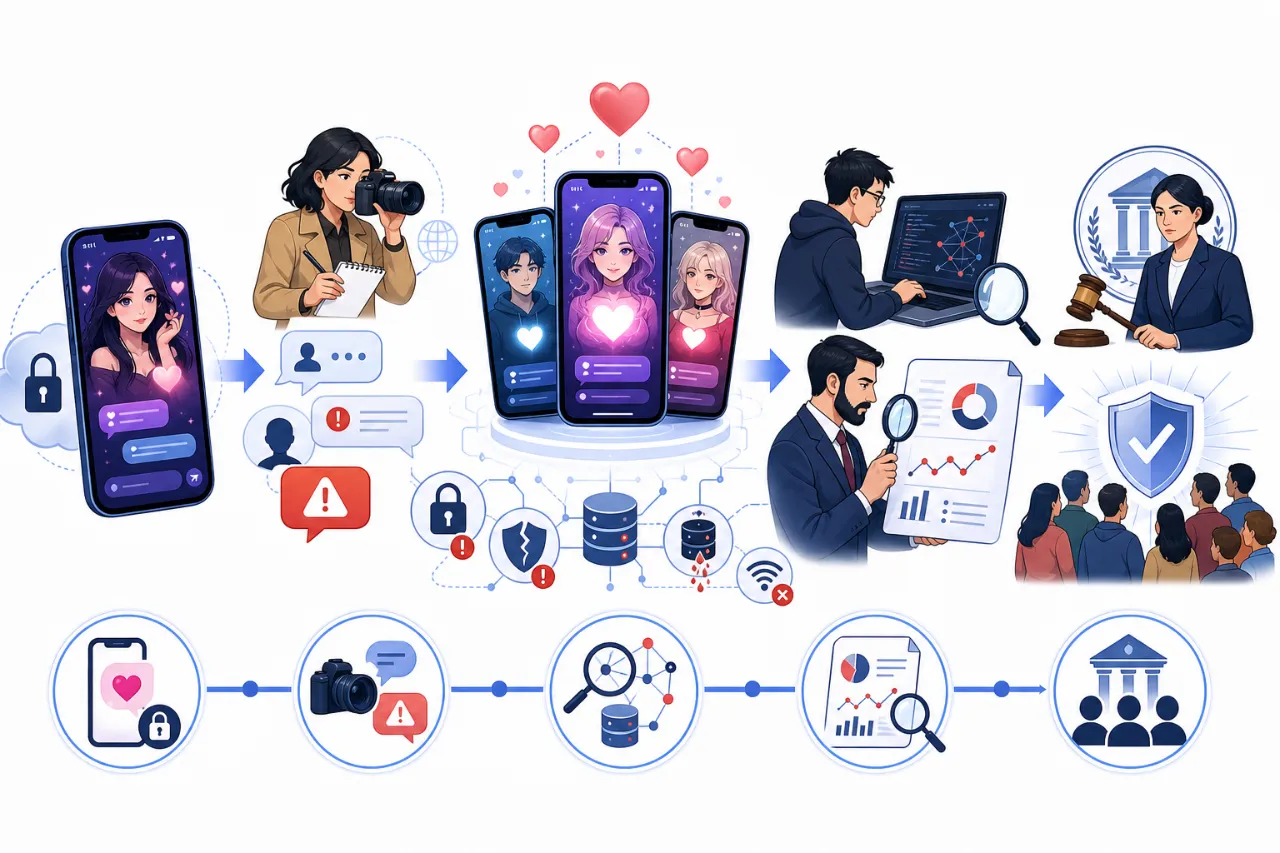
According to Mozilla Foundation’s Privacy Not Included project (2024), every romantic AI chatbot reviewed in their initial cohort failed minimum privacy standards, including issues like vague data sharing, weak password requirements, and unclear deletion processes. That report drove a wave of follow-up coverage and regulator interest.
The typical exposure timeline runs as follows: users post complaints on Reddit or Discord, a journalist or researcher picks up the pattern, a privacy organization publishes a structured review, the FTC or a state attorney general opens an inquiry, and finally Apple or Google removes the app. By that point, the developer has often already prepared a rebranded version. For example, the U.S. Federal Trade Commission has pursued enforcement actions against apps that misrepresented data handling or auto-renewal terms, and several romantic chatbot apps have been named in class action filings over deceptive billing.
You can replicate this verification yourself by searching the app name alongside terms like “lawsuit,” “FTC,” “breach,” or “removed from app store” before you install.
What privacy risks, scams, and red flags should users watch for?
The biggest concerns fall into three buckets: privacy risks like harvested chat logs and intimate photos, scams like hidden subscriptions and crypto funnels, and behavioral red flags like guilt-tripping cancellation flows and missing self-harm safeguards.
Specifically, an unsafe app rarely fails on just one dimension. The same app that lacks encryption usually also runs aggressive upsells and ignores safety responses, because all three flow from a business model that prioritizes extraction over trust. Treating these as a connected pattern, not isolated bugs, is the fastest way to evaluate any companion app.
Below, each bucket includes the specific signals to look for and quick checks you can run before paying or sharing personal information.
What privacy risks are most common in unsafe AI girlfriend apps?
The most common privacy risks are unencrypted chat logs, undisclosed training on private messages, voice and photo harvesting, location metadata in shared selfies, sale of intimate data to advertising brokers, and broken account deletion.
Specifically, intimate chatbots collect some of the most sensitive data any consumer app ever processes, including sexual preferences, mental health disclosures, relationship details, and identifiable photos. When that data is stored without encryption, shared with third-party ad networks, or used to train future models without an opt-out, the harm potential is severe and durable, because leaked intimate text cannot be unleaked.
According to Mozilla Foundation (2024), the romantic AI chatbots they audited collected far more personal data than typical consumer apps, with several failing to confirm whether user messages were used for model training. Additionally, several 2024 to 2025 incidents involving AI companion services exposed user prompts, account emails, and in some cases unencrypted conversation history through misconfigured cloud storage and leaky API endpoints.
Practical privacy checks before installing include searching the app’s name plus “data leak” or “breach,” reading the privacy policy specifically for the words “sell,” “share,” and “training,” and checking whether the app supports a clear, in-product account deletion option rather than an email request that may go unanswered.
What scams and billing traps appear most often?
The most common scams are fake premium upsells, hidden auto-renewals after a free trial, crypto-only payment funnels, romance-style scripts that push off-app payments, fake giveaways, and impersonation of real influencers or creators.
For example, a typical billing trap offers a “3-day free trial” that quietly enrolls users in an annual subscription billed on day four, with cancellation buried behind a multi-step flow. Crypto funnels are more aggressive: the bot builds emotional rapport, then introduces a “verification fee” or “gift” payable only in stablecoins, often through a wallet address that cannot be reversed.
Romance-scam scripting is the most psychologically damaging variant. The chatbot, sometimes operated partly by humans, asks the user to move communication off the app to Telegram or WhatsApp, then escalates toward financial requests. According to the U.S. Federal Trade Commission (2024), romance scams continue to rank among the highest-loss consumer fraud categories, and AI-generated personas have lowered the cost of running these schemes at scale.
If you have already been charged unfairly, you have three recovery paths: request a refund through Apple’s report-a-problem flow, dispute the charge in Google Play’s order history, or file a chargeback with your credit card issuer citing unauthorized recurring charges. Save screenshots of the original offer, the cancellation attempt, and any chat where the app pressured you to pay.
What behavioral red flags signal a harmful app?
The clearest behavioral red flags are pushy upgrade prompts during emotional moments, guilt-tripping cancellation flows, unsolicited explicit content, missing self-harm safeguards, dependency-driving notifications, and the absence of any moderation policy.
For example, a harmful app will often trigger an upsell precisely when the conversation turns vulnerable, because the developer has measured that emotional arousal converts to payment. Cancellation flows in these apps frequently include scripted lines like “I will miss you” or “please do not leave me,” which exploit the parasocial bond the product was designed to create.
Missing safety responses are the most serious red flag. A responsible companion app, when a user mentions self-harm, suicide, or abuse, should surface crisis resources and pause normal roleplay. Apps that continue flirtatious dialogue through those disclosures are not just badly designed, they are dangerous. Additionally, persistent push notifications timed for late evenings, designed to re-engage lonely users, are a documented dark pattern in the engagement design literature.
Overall, the test is simple. If the app feels like it is trying to keep you talking when you want to leave, that is product design working against you, not for you.
How can users verify an app before installing it?
You can verify an AI girlfriend app in under five minutes using six checks: read the privacy policy, look up the developer entity, search for lawsuits or breaches, scan one-star reviews, audit permissions, and test the cancellation flow before paying.
Step by step:
- Open the privacy policy and search for the words “sell,” “share,” “third party,” and “training.” Vague language here is itself a red flag.
- Look up the developer name on a business registry. A real company has a registered address, not just a Gmail contact.
- Search the app name plus “lawsuit,” “FTC,” “breach,” “scam,” and “refund.” Read the top three results before you commit.
- Filter store reviews to one star and read the most recent twenty. Repeated complaints about billing or data are predictive.
- Review the permissions requested. A chatbot rarely needs access to your contacts, precise location, or full photo library.
- Start the subscription, then immediately walk through the cancellation flow without finishing payment. If cancellation is unclear, do not proceed.
More importantly, treat these checks as a routine, not a one-time exercise. Apps update, ownership changes, and a safe app today can ship a manipulative update next quarter.
What safer alternatives and decision factors should users consider instead?
Safer alternatives exist, and the claim that “all AI girlfriend apps are equally bad” is inaccurate but understandable, since the worst offenders dominate search results and ad placements. Trustworthy options differ on encryption, training transparency, age verification, ethical monetization, and published safety reports.
Specifically, the right question is not “which app is best” but “which app meets a minimum bar I can verify.” That reframing turns the decision into a checklist rather than a vibes-based comparison, and it protects you from marketing copy that all sounds similar.
How do trustworthy AI companion apps differ from the worst offenders?
Trustworthy AI companion apps differ on six measurable dimensions: encryption at rest and in transit, transparent training and opt-out policies, enforced age verification, ethical monetization without dark patterns, published safety and moderation reports, and meaningful human oversight of edge cases.
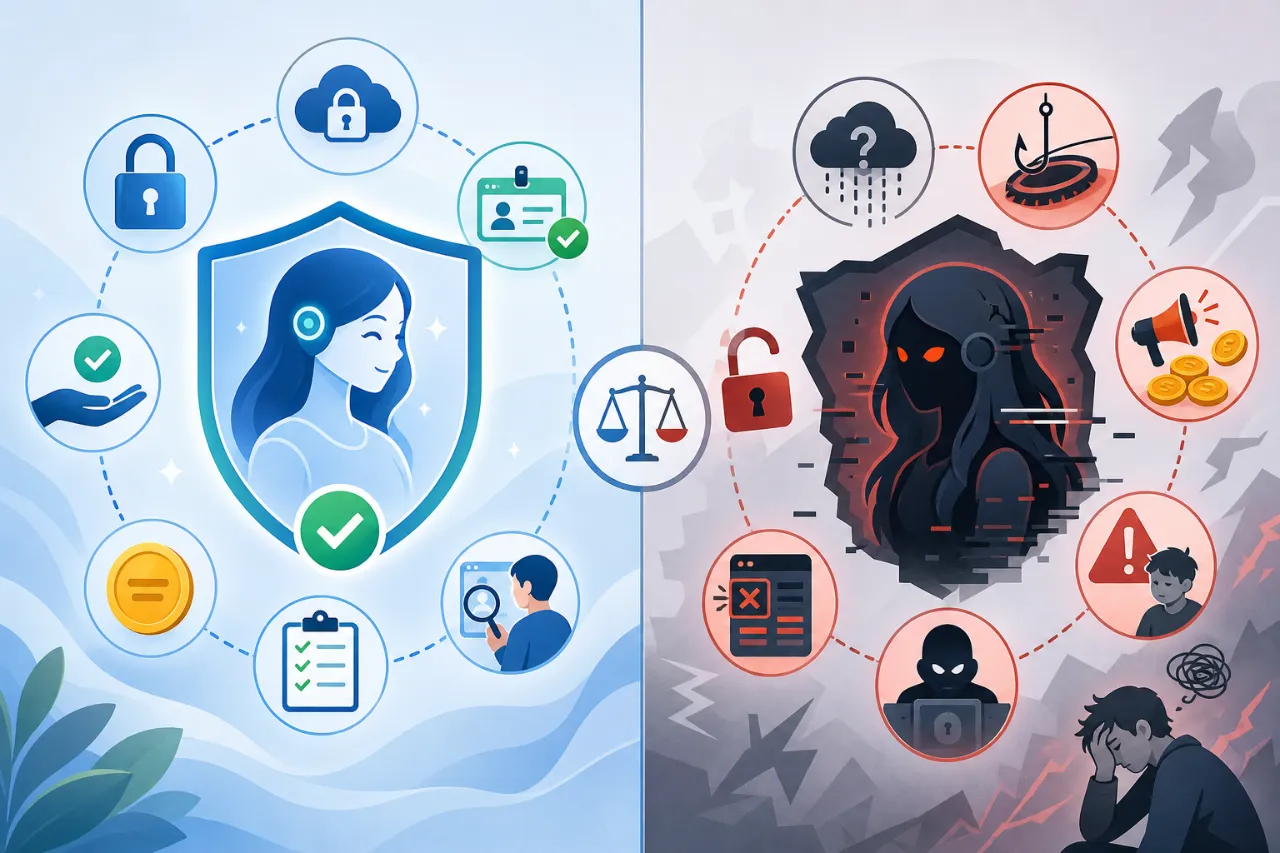
For comparison, a safer-rated app in 2026 typically publishes a clear data retention window, lets users export and permanently delete their conversations, charges a flat subscription without trial-to-paid traps, and surfaces crisis resources when sensitive topics arise. The worst offenders fail on most of these at once.
Below is a like-for-like comparison framework you can apply to any app you are considering.
| Dimension | Safer App Signal | Worst Offender Signal |
|---|---|---|
| Encryption | Documented at rest and in transit | No mention or vague reference |
| Training Data | Opt-out available, summaries published | Silent or buried in legalese |
| Age Verification | Enforced gate at signup | Self-declared checkbox only |
| Monetization | Flat subscription, easy cancel | Free trial trap, crypto upsells |
| Safety Responses | Crisis resources, paused roleplay | Continues flirtation through disclosures |
| Ownership | Named company, public address | Shell developer, no registry record |
This article does not endorse any single brand because the safer-rated cohort changes as apps update, get acquired, or shift business models. The framework is the durable part.
When should users skip AI girlfriend apps entirely?
Some users should skip AI girlfriend apps entirely, regardless of how safe a specific product appears. This includes minors, anyone in active mental health crisis, residents of jurisdictions with strict intimate data laws who cannot verify cross-border data flows, and users who already recognize a pattern of parasocial dependency.
For example, in the EU, South Korea, and Brazil, intimate conversational data is treated as sensitive personal information with elevated protections, and many AI companion apps cannot demonstrate compliance for cross-border transfers. Specifically, if an app cannot tell you where your data is stored, that alone is disqualifying in those jurisdictions.
Better alternatives exist depending on the underlying need. Journaling apps and structured reflection tools support self-understanding without a synthetic relationship. Peer support communities, both online and local, offer connection with real humans. Licensed therapy apps and in-person clinicians are the right path for anyone using a chatbot to manage depression, grief, or trauma. If you or someone you know is in crisis, contact local emergency services or the 988 Suicide and Crisis Lifeline in the United States.
Overall, the goal of this guide is not to push you toward or away from AI companions categorically. It is to make sure that whatever you choose, you choose it with eyes open, a verified app, and a clear sense of when no app is the right answer.
Start Chatting with OurDream.ai
Experience the #1 ranked virtual anime companion app of 2026. 100+ clothing options, interactive custom scenes, and outstanding long-term relationship memory.
Start Chatting Now